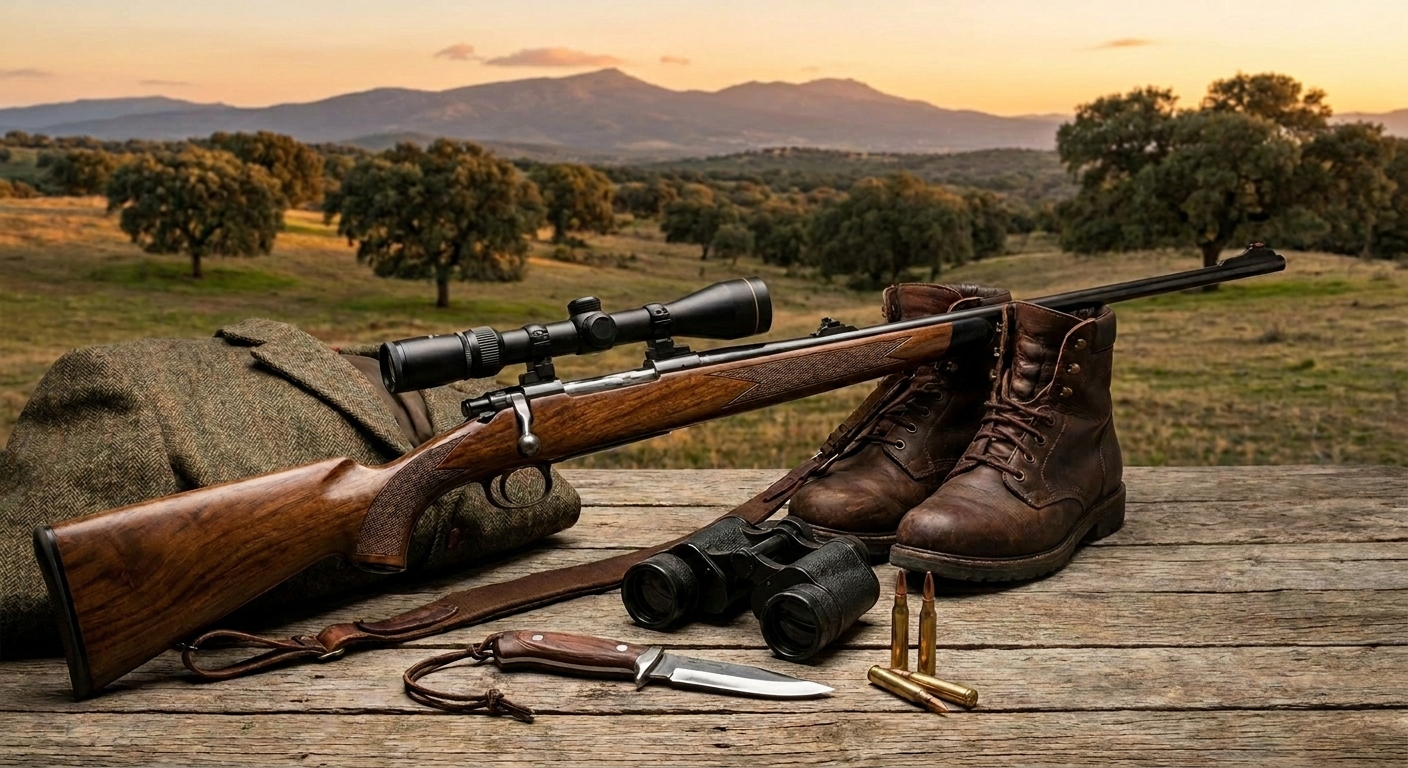
Spain is one of the most important hunting destinations in the world. From the imposing Gredos ibex to the deer belling in the mountains of Sierra Morena, and the wild boar found in every corner of the peninsula, our country offers a variety of species and modalities that few territories can match. However, fully enjoying a day and, above all, returning home with success and safety, depends largely on one decisive factor: having the right equipment for each big game hunting modality.
In this guide, we review, piece by piece, everything a hunter should take to the mountains, whether practicing stalking, montería, or waiting.
Why is it so important to choose big game hunting equipment well?
Big game hunting in Spain is mainly practiced in three modalities—stalking (rececho), montería/driven hunt (batida), and waiting or ambush (aguardo)—and each requires specific equipment. A perfect rifle for a wild boar montería in Sierra Morena may be inadequate for a chamois stalking in the Pyrenees. Similarly, the boots we would use for a night wait are not suitable for walking ten kilometers following the tracks of a mountain ibex.
Choosing equipment well means greater precision, more comfort, greater safety and, ultimately, more success in the field.
The rifle: the heart of big game hunting equipment
The rifle is, without a doubt, the most important piece of equipment. The choice will depend on the modality practiced:
Rifles for stalking
In stalking, we look for precision at medium and long distances. Bolt action rifles are the undisputed kings, thanks to their accuracy, reliability, and robustness. Brands like Sauer, Mauser, Blaser, Tikka, Sako, Bergara, or Steyr Mannlicher are references in the Spanish market.
Rifles for montería and driven hunts
Here, shot speed takes precedence over long-distance precision. Shots usually occur between 20 and 100 meters on moving game. The most recommended options are:
Semiautomatic rifles: shooting speed and the possibility of three consecutive shots.
Express rifles (break-action): two barrels for two almost simultaneous shots, very instinctive.
Lever action rifles: fast and economical, ideal for short distances.
Recommended calibers for big game hunting in Spain
The choice of caliber is one of the eternal debates among hunters. Below are the most used in our country:
Versatile calibers (valid for almost everything)
.30-06 Springfield: probably the most popular in Spain. Versatile, with great ammunition availability and valid for any big game species.
.308 Winchester: versatile, precise, and with less recoil than the .30-06. Excellent for stalking and waits.
7 mm Remington Magnum: ideal for large game and long distances (deer, fallow deer, mountain ibex, Barbary sheep).
Specific calibers for montería and driven hunts
9,3x74R: the king of Spanish monterías. Heavy bullet, great stopping power, perfect for wild boar and deer at short range.
8x68S: the "German magnum," very fast and punchy.
.300 Winchester Magnum: great energy and range, although with considerable recoil.
Calibers for medium game and precision stalking
6,5 Creedmoor: on the rise for its precision, flat trajectory, and low recoil. Excellent for roe deer, chamois, and mountain goat.
.270 Winchester: a timeless classic with a very notable balance.
.243 Winchester: light, ideal for roe deer and fox.
Tip: If you are looking for a single rifle for all modalities, the .30-06 Springfield remains the safest and most versatile bet in Spain.
Optics: the second great pillar
A good rifle without proper optics loses much of its potential.
Scopes
For montería: low magnification scopes (1-6x, 1-8x, or even 1-10x) with a red dot or illuminated reticle. They allow for quick target acquisition and shooting at moving game.
For stalking: variable scopes such as 2.5-15x, 3-18x, or even 5-25x for long distances. Top brands: Swarovski, Zeiss, Leica, Kahles, Schmidt & Bender, Vortex.
For night waits: scopes with good luminosity and, where legislation permits, night vision or thermal devices (Pulsar, ATN, InfiRay).
Binoculars and rangefinders
Essential in stalking and waiting. 8x42 or 10x42 binoculars are the most versatile. The rangefinder is fundamental for knowing the exact distance before the shot: many modern models integrate both functions (rangefinder binoculars).
Technical clothing: comfort, camouflage, and resistance
The choice of clothing changes radically depending on the modality and the time of year.
For stalking
We need lightweight, breathable, silent garments with a layering system. Brands like Härkila, Seeland, Chevalier, Pinewood, Beretta, or Sitka Gear offer specific lines:
Technical long-sleeved T-shirt (merino wool or synthetic).
Fleece or intermediate jacket.
Waterproof and windproof outer jacket (Gore-Tex type membranes).
Technical pants reinforced at the knees and seat.
For montería
Regulations require high-visibility garments (fluorescent orange vest or cap) for safety. Clothing must be resistant to brambles and brush. Montería jackets usually include integrated cartridge belts and large pockets.
For waits and ambushes
Warmth is priority. In winter, garments with down filling or synthetic insulation, thermal underwear, and silent gloves. The silence of the fabric is key: no crinkly plastics.
Footwear: the base of every good day
Boots are as important as the rifle. Bad boots can ruin a thousand-euro hunt.
For mountain stalking: high, rigid boots with a Vibram-type sole, waterproof and with good ankle support. Brands: Meindl, Hanwag, Lowa, Crispi, Zamberlan.
For montería: mid-cut boots, lightweight and moisture-resistant.
For waits: thermal boots with insulation (Thinsulate or similar).
Always wear technical socks (merino wool) and, if you go on long routes, a spare pair in your backpack.
Backpack and essential accessories
A good hunting backpack (between 20 and 35 liters for stalking) should be comfortable, silent, and with compartments designed to carry the rifle, binoculars, and ammunition.
Basic equipment that should never be missing
Knife and finishing dagger: brands like Muela, Joker, or Cudeman are national references.
Bipod or shooting tripod: fundamental for precise shots in stalking.
Headlamp with white and red light.
GPS or hunting application (CazApp, OnX, CompeGPS).
Basic first aid kit and thermal blanket.
Canteen or camel-bag and energy food (nuts, bars, chocolate).
Silent gloves and neck gaiter.
Marking tape and bags for viscera (important for health and traceability of the piece).
Documentation: the unseen but mandatory equipment
Without proper documentation, no hunting is possible. Before going out to the mountains, check:
Valid hunting license for the corresponding autonomous community.
Weapon permit (type D for rifles, type E for shotguns).
Firearm registration guide (Guía de pertenencia).
Hunter's civil liability insurance (mandatory).
Permit from the hunting ground or authorization from the hunting rights holder.
ID card (DNI) and, in some communities, certificate of aptitude or safety course.
Final tips for getting your equipment right
Invest progressively. It is better to buy a few good things than many cheap ones.
Try before you buy. Visit specialized gun shops and, if possible, fire the rifle beforehand.
Maintain your gear. Clean the rifle after each outing, oil knives, and check the optics.
Adapt the equipment to the modality. There is no perfect universal equipment.
Ask for advice from experienced hunters and, above all, from your trusted gunsmith.
Conclusion
Big game hunting equipment in Spain is a combination of weapon, optics, clothing, footwear, and accessories that must adapt to the terrain, species, and modality. Whether you are starting in roe deer stalking, preparing for your first wild boar montería, or a mountain ibex Grand Slam, taking the time to choose your equipment well will make the difference between a frustrating day and an unforgettable memory.
Big game hunting demands respect for the animal, for the mountains, and for oneself, and the first gesture of respect is going out into the field with the right equipment.